
Guide for lenders
Mortgage automation software: a practical buyer’s guide.
Most lenders do not have a technology problem. They have a process they have never written down, and a vendor list they are trying to choose from anyway. This guide is the order of operations I use with banks, credit unions, and independent mortgage banks — what to automate first, what to ask vendors, and what has to be in place before anything goes live.
What Mortgage Automation Software Actually Is
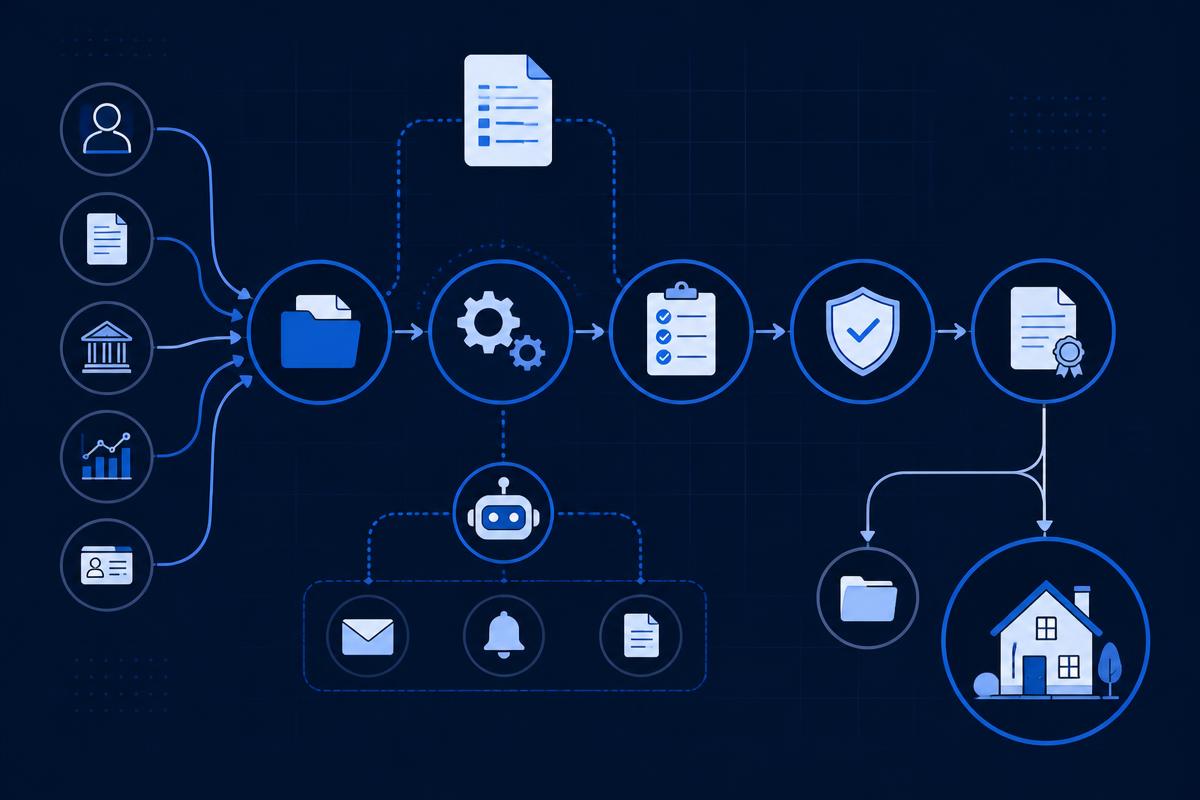
The category covers any software that removes manual steps from originating, underwriting, closing, or servicing a loan. In practice it shows up in four forms: rules-based workflow inside your loan origination system, document and data extraction, point solutions that handle one task well, and newer AI-assisted tools that summarize, check, or draft.
They are not interchangeable. Rules-based workflow is predictable and easy to audit. Extraction is probabilistic and needs confidence thresholds and human review. AI assistance needs governance and disclosure. Buying them as if they carry the same risk is the most expensive mistake in this market.
Where it pays off
Six Places Automation Earns Its Cost First.
Document Intake and Classification
Splitting, naming, and indexing borrower documents is high-volume, rules-friendly work. This is usually the fastest measurable win, and the easiest to audit because you can compare machine output to the file.
Income and Asset Data Extraction
Automation reads paystubs, W-2s, bank statements, and tax transcripts into structured fields. Value depends entirely on confidence scoring and a clean exception path back to a human.
Conditions and Status Communication
Borrower and referral-partner updates are the most common source of complaints and the easiest thing to automate well. Low risk, immediate satisfaction gains.
Underwriting Decision Support
Not decisioning — support. Surfacing guideline hits, calculation checks, and inconsistencies for an underwriter who still owns the call and can explain it.
QC, Audit, and Post-Close Review
Sampling every file instead of a slice changes your risk picture. It also generates the evidence trail examiners increasingly expect from automated processes.
Servicing and Retention Triggers
Portfolio monitoring for rate, equity, and life-event signals. Straightforward automation with direct revenue attribution.
Order of operations
How to Evaluate and Roll It Out.
- 01
Name the Problem in Numbers
Not "we need AI." Instead: touches per file, cycle time by stage, conditions per loan, rework rate, cost per loan. If you can’t measure it now, you can’t prove the software worked.
- 02
Pick One Process, End to End
One stage, one team, one measurable outcome. Broad platform rollouts stall because nobody owns them. Narrow projects finish and create internal proof.
- 03
Set Governance Before You Sign
Decide up front who approves the use case, what the human review threshold is, how you document decisions, and what triggers a shutdown. Retrofitting this after go-live is where exam findings come from.
- 04
Pilot Against a Real Backlog
Run your own files, including the ugly ones. Score accuracy, exception volume, and how much time the exception handling actually costs.
- 05
Train for the New Job, Not the Tool
Adoption fails when people are shown buttons instead of being told how their role changed. Rewrite the procedure, then teach it.
- 06
Measure, Then Expand
Compare to your baseline at 30, 60, and 90 days. Expand only what cleared the bar. Shelfware is almost always the result of expanding on hope.
Vendor diligence
Choosing an AI Vendor Partner: Ten Questions to Ask Before You Sign.
An AI vendor partner is a long-term dependency, not a purchase. These ten questions separate the vendors who can support a regulated lender from the ones who can only demo well.
- Show me the exception path. What happens when the model is unsure, and who sees it?
- What is your accuracy rate on documents that look like mine — not your demo set?
- Can you produce a record of every automated decision, with inputs, version, and timestamp?
- How does this write back to my LOS, and who owns the integration when it breaks?
- Which of your customers are my size, in my channel, and may I speak with two of them?
- What is included in implementation, and what becomes a change order?
- How do you handle model updates? Do I get notice, testing time, and a rollback?
- Where does my data live, who can see it, and is any of it used to train shared models?
- What does fair lending testing look like for anything that touches borrower treatment?
- What is the true first-year cost — license, implementation, integration, internal hours?
Avoid these
Why Automation Projects Become Shelfware.
- Buying a platform before defining a process — the software inherits your bottleneck.
- Counting license cost as the cost. Integration and internal hours usually exceed it.
- No exception owner, so exceptions quietly pile up until staff route around the system.
- Treating vendor accuracy claims as your accuracy. Your document mix is not their demo.
- No documentation of automated decisions, which turns a productivity win into an audit problem.
- Skipping the people work. Unused automation costs more than manual work did.
Next step
Want a Second Opinion Before You Buy?
I help lenders scope the use case, pressure-test vendors, and put the governance in place so automation survives its first exam and its first busy month. Bring your shortlist to a discovery call, or read how the consulting engagements are structured.